How to Know You’re in Labor
Is This Real Labor? How to Tell When It’s Actually Go-Time
It was 5am and my phone woke me up.
Me: “Hello?” Her: “I think I just felt a contraction!”
Me (half asleep and very confused): “Okay. Is that what you called for? What’s going on?”
Her (panicked): “Everyone says I’ll know when I’m in labor! WTF does that even mean? How will I know??”
After answering as best I could and helping her breathe through the uncertainty, I finished with a simple truth: “I promise you will know.”
Eventually, we realized it was indeed her birthing time. When I joined her at the hospital later that day, she looked at me and yelled, “YES! YES! I know! I get it! I know now!”
The final weeks of pregnancy are a mental marathon. Every cramp, backache, or wave of nausea brings up the same high-stakes question: Is this it?
Signs of Early Labor vs. Active Labor
The frustrating truth is that even the most experienced Atlanta Doulas can’t always tell you if labor has started over the phone. The only way to know if a sensation is "the real deal" is to wait and see if it builds.
True labor will grow, intensify, and eventually demand your full attention. If it doesn't, it might just be your body warming up. Instead of spiraling over the mystery, here is how to navigate the uncertainty with your sanity intact.

What to Ask Yourself Instead of "Is This Real Labor?"
Instead of trying to solve the mystery, focus on what is actually useful for your physical and mental state. Ask yourself:
Hydration: Have I had enough water?
Preparation: If I have my baby tomorrow, what will I wish I had done today?
Nutrition: Have I eaten a high-protein or high-carb snack recently?
Rest: Should I try to nap now in case things ramp up tonight?
Positioning: Would a position change or the Miles Circuit help the baby align better?
Progression: Are things getting stronger, longer, and closer together?
The real work in the beginning isn’t being a detective; it’s taking good care of yourself while you wait for the answer to declare itself.
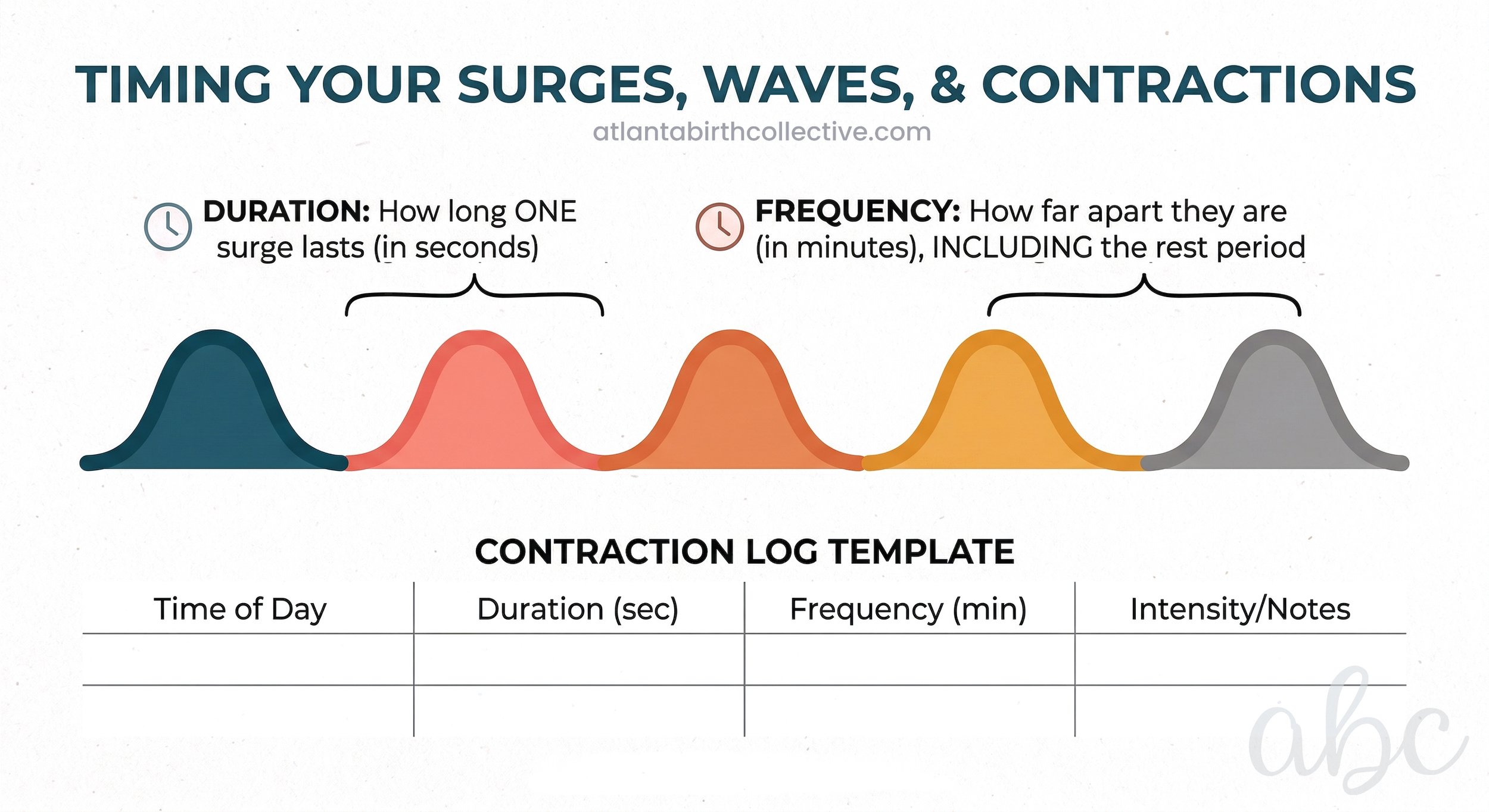
How to Time Your Waves, Surges, Contractions
The diagram serves as a visual map of the labor pattern. The peaks represent the rising and falling intensity of the uterine work. A horizontal bracket over a single peak indicates the duration, while the longer bracket stretching from the start of one peak to the start of the next represents the frequency. This visual emphasizes that labor is a series of waves with necessary rest periods in between. Below the map is a log to track the time of day, the length of each surge, the interval between them, and notes on the level of discomfort.
A timer should be started at the very first sign of the uterine muscles tightening or at the onset of discomfort.
The timer is stopped only when the sensation has completely faded and the abdomen feels soft again to record the duration in seconds.
The start time of the next surge is noted to calculate the frequency in minutes, which includes both the working phase and the rest period.
These numbers should be recorded in the log for 30 to 60 minutes whenever the rhythm of labor seems to shift or intensify.
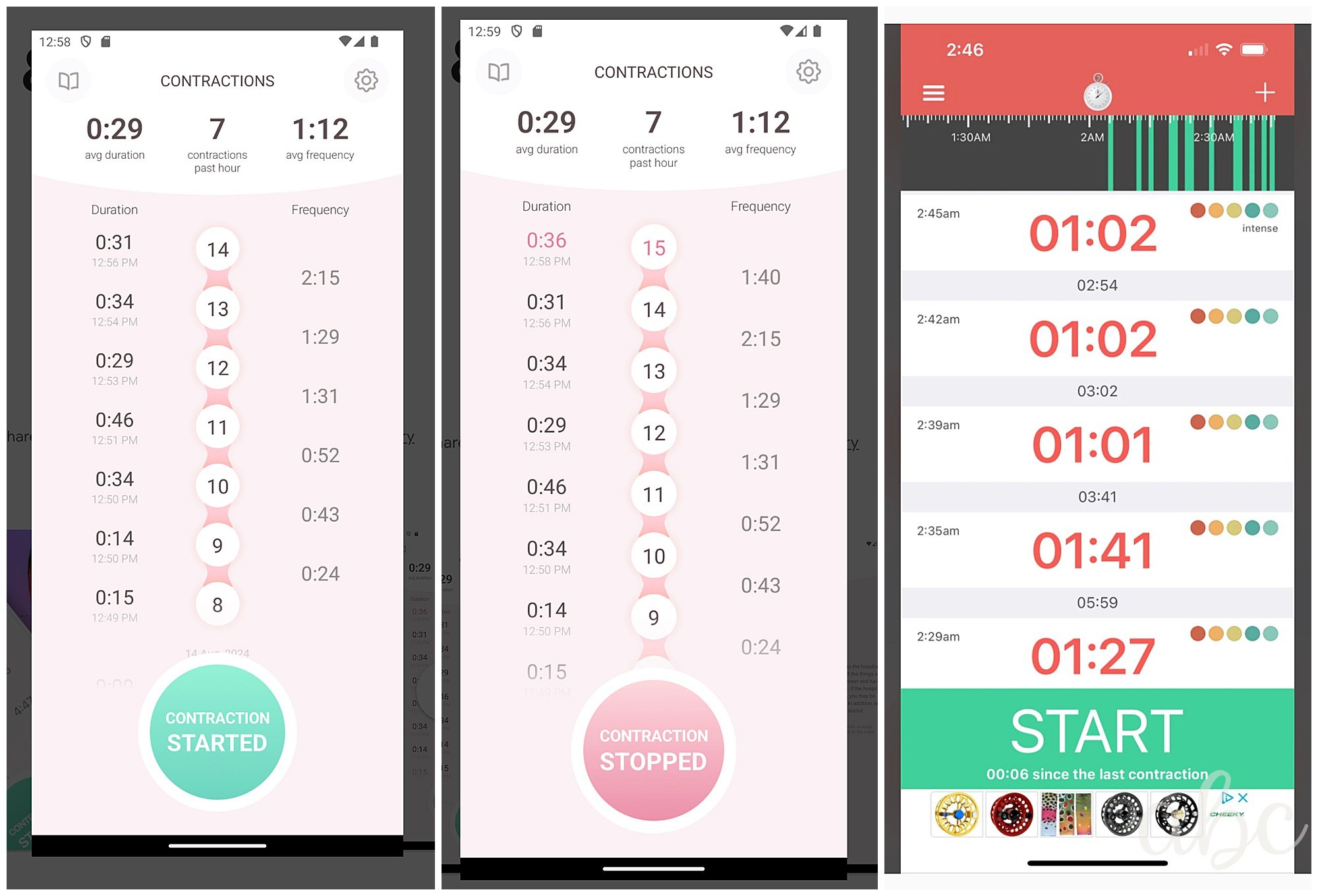
Example screenshots we receive of contraction/wave patterns.
Understanding Prodromal Labor
If you’ve been having contractions at the same intensity for four hours and they never really build, it might be prodromal labor or your body simply warming up. This isn't "fake" labor. It’s real physical work, but it isn't active labor yet.
We are always looking for growth. True labor that is progressing usually does not stay mild and unchanged forever. We want to know:
Intensity: Are the waves getting stronger?
Communication: Are they becoming harder to talk through?
Focus: Are they pulling 100% of your focus?

When to Text or Call Your Doula
At Atlanta Birth Collective, we don't want you to filter yourself. We want to know what’s happening so we can help you track the "big picture." We love hearing from you and there is no such thing as TMI. We love photos and all the details!
Day & Evening (9 AM – 9 PM): Text us updates on everything: diarrhea, loss of mucus plug, bloody show, or irregular discomfort. You can also call for anything you need during these hours, but we prefer you text first to make sure we aren’t sleeping. We regularly try to nap as your EDD approaches.
Overnight (Midnight – 8 AM): Text updates are still fine (they won't wake us!), but call if you need us immediately or have a question that cannot wait. Do try to let everyone sleep if possible. You should be trying to sleep too!
A few "Do Not Wake Us" recommendations: You’ll need us strong and alert when the real work begins.
If your water breaks but nothing else is happening, go to sleep.
If you see spotting/mucus, go to sleep.
If waves have started but you are still coping well, go to sleep.
If you think you are in labor and just want to “give us a heads up”, but don’t actually need us. Instead, a great “heads up” is when you know you will need support soon. Since it will take us some time to get to you.

The 4-1-1 Rule vs. Real Life Coping
Many families are taught to focus only on contraction timing, but in real life, how labor feels matters just as much as what the timer says.
For hospital births, we generally follow the 4-1-1 rule (4 minutes apart, 1 minute long, for 1 hour). For first time moms, we’ve noticed they often aren’t uncomfortable until closer to 3-1-1.
However, we look at more than just a contraction timer. We look at how you are feeling. If your contractions are 6 minutes apart but powerful enough that you cannot talk through them, we pay attention to that.
Some people wake up with contractions every 3 minutes and feel a sense of urgency/panic to go to the hospital, but if they are still walking and talking through them, they aren't in active labor yet.
Our team is generally called to the hospital once you are in active labor (generally around 6 centimeters). On the other hand, if you are 2 cm dilated, but the discomfort is so intense that you cannot speak or catch your breath, that is a clear sign you need support now.
We are 100% okay with that! We will show up when you need us. However, we also believe in being realistic: If your discomfort is that intense very early on, there is a strong chance you may want an epidural later, and that usually creates a natural rest window for everyone.
You will get some much-needed sleep, and your doula team will also be taking a nap. We do this intentionally so that when it’s time to start the hard work of positional changes or even pushing, everyone is rested, alert, and ready!

The Logistics: Contracted Hours vs. Hourly Rates
We love being there for you, and we also want to be thoughtful about how your support hours are used. Most Atlanta Birth Collective birth packages include a set number of contracted hours for continuous labor support.
We want you to use those hours wisely, not burn through them during a long stretch of very early labor when you are still coping well on your own. If we are called in very early, while labor is still mild and you are coping well, there is a chance those hours may be used before labor really intensifies. If labor becomes very long and support extends beyond the hours included in your package, additional time shifts to an hourly rate.
This is one reason we often encourage families to watch and wait in early labor when it is appropriate. We want your contracted hours to be used when support is most needed, especially during active labor, transition, and the more demanding parts of the experience. Resting when you can, staying home while things are still manageable, and calling us when hands-on support is truly needed helps protect both your energy and your budget.
Many parents also dilate better when they are not being watched too closely. Labor often unfolds more smoothly when there is privacy, less pressure, and less focus on “performing” progress. Sometimes the best thing you can do in early labor is hydrate, rest, dim the lights, and let your body work without an audience.
Early Labor Support from a Third Doula
Labor can sometimes last 24 to 36 hours, and some families want in-person support well before active labor begins. In those situations, we may occasionally send a third doula to offer early labor support so your primary doulas can rest and be fully ready when labor picks up.
This approach helps us preserve energy where it matters most. Your primary team can stay rested, focused, and available for the more intense stages of labor, while you still receive caring, professional support in the beginning if that is something you want. Everyone on our team is experienced and aligned with our standards of care, so you can expect steady, high-quality support from start to finish.

When to Call Your Midwife or OB/GYN
Safety always comes first. Call your provider immediately, regardless of your contraction pattern, if you experience:
Heavy, bright red blood pouring out of you.
A significant decrease in fetal movement.
Fever or signs of infection.
Water breaking that is green, brown, or foul-smelling.
A personal history of very fast labors (we don't treat a third baby the same as a first!).
When to Go to the Hospital in Labor
For most hospital births, it is usually too early to go in with the first contractions, bloody show, or a vague sense that “something is happening.” In general, we are looking for a pattern that is building, discomfort that is becoming harder to manage, or provider-specific instructions that change the plan. The contraction timer matters, but so does how you are coping. If you are still able to talk, walk, snack, hydrate, and rest comfortably, it is often too soon to leave for the hospital.
The Blunt Version
You can drive yourself crazy trying to figure out whether every symptom means the baby is coming. Usually, the answer is simple: If it is labor, it will become labor. If it is not, it will fade, stall, or stay the same.
Your job in the beginning is to hydrate, rest, eat, and wait.

Expert Birth Support in North Atlanta
Navigating the “Is this it?” phase is much easier when you have experienced support in your corner. At Atlanta Birth Collective, we provide doula support for families in Roswell, Woodstock, Alpharetta, Canton, and throughout North Atlanta. We help families navigate common labor questions like when to stay home, when to call, and when it’s time to head to the hospital.