Early Labor At Home
Once you have crossed the bridge from "is this labor?" to "this is definitely labor," the focus shifts from questioning to doing. At Atlanta Birth Collective, we believe the best birth plan is a curated one. While every birthing person has unique needs and timelines, we utilize a core protocol to keep things moving smoothly while you are still navigating contractions in your own space. Whether your plan involves staying home for the duration or eventually transitioning to a birth center or hospital, these steps help optimize your environment and your body.

It’s so easy to be excited about your birthing day! But REST takes priority! If you’re still smiling and/or chatting, it’s too early for your doula to join you. Utilize your doula when you need support the most.
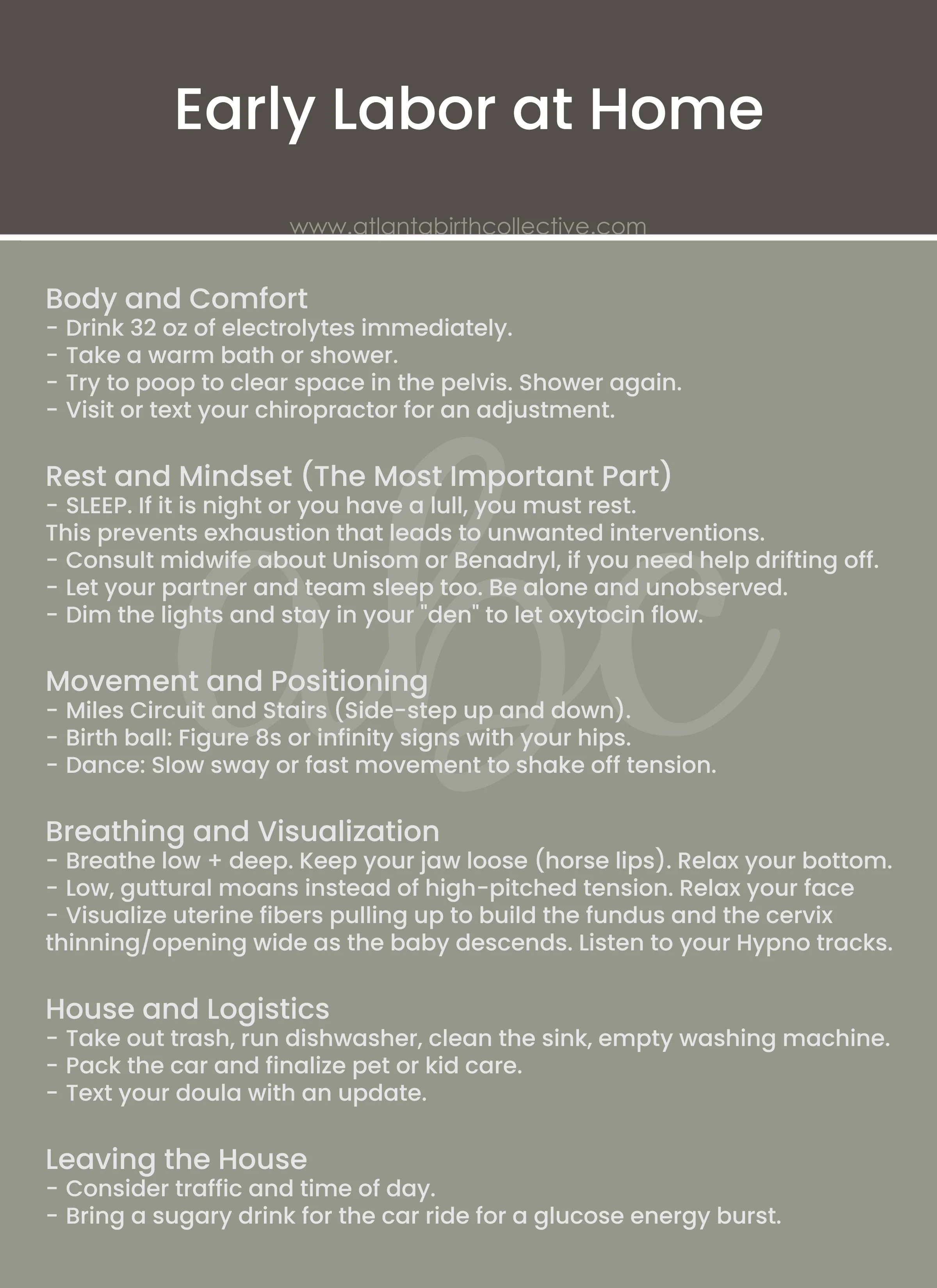
Early Labor Protocol: Hydration and the Tub
Labor is an athletic event, and your uterus is the primary athlete. It needs fuel to perform. Our protocol starts with drinking 32 ounces of an electrolyte-rich beverage. Dehydration can lead to uterine irritability or stall progress, so getting those minerals in early is essential for uterine efficiency.
Once you have hydrated, head to the tub or take a warm shower. Warm water is often referred to as the midwife’s epidural for a reason. It encourages the pelvic floor to soften and allows you to experience the buoyancy that takes the weight off your joints. This is also a good time to try to poop. Clearing the bowels can create more space in the pelvis and often helps labor progress more comfortably. If you are in established labor, the water won’t stop the process, but it will help you manage the intensity of each wave and find your rhythm.

The Absolute Necessity of Sleep
If there is one piece of advice that moms tend to ignore, and later regret more than anything else, it is the directive to sleep. We hear it constantly: "I wish I had listened and slept." Not sleeping during this phase is the number one reason we see people request an epidural earlier than they intended. It isn't usually the pain that breaks a person; it is the sheer, bone-deep exhaustion of being awake for 24 hours before the hard work even begins. If it is nighttime, or if you can find even a small window of quiet during the day, you must rest. Let your partner and your birth team sleep as well. If the excitement or the physical sensations make sleep feel impossible, tools like Benadryl, Unisom, or even a small glass of wine can help you drift off. Consult with your midwife. Conserving your energy now is the best gift you can give your future self when it is time to push.

Client is in “Side Lying Release” position. This is a Spinning Babies move that Milène encouraged her client to try, to get baby to come down more.
Miles Circuit and Movement to Progress Labor
After a solid nap (hopefully in extreme side-lying position), It’s time to help baby find the optimal path through the pelvis. We recommend a variety of movements to create space and encourage descent. Start with the Miles Circuit.
Beyond the circuit, utilize your birth ball to create infinity signs or figure-8 motions with your hips. This helps the baby's head navigate the pelvic bones. Don’t be afraid to put on some music and dance! Whether it is a slow sway or a faster rhythm to "shake it off" and release tension, also incorporate holding a squat to use gravity to your advantage. This is also the ideal time to visit or text your chiropractor and try to squeeze in a Webster-certified adjustment. Keeping your nervous system clear and your pelvis aligned can significantly impact how efficiently your body opens.
Listen to Healing Frequencies and Hypnobirthing Tracks
If you find your mind racing or your body struggling to settle, hypnobirthing tracks can be a powerful anchor during your home protocol. These tracks often utilize specific frequencies to support your nervous system and help you drop into a more relaxed state. We recommend looking for tracks tuned to 432 Hz, often called the heartbeat of the Earth, which promotes deep relaxation and grounding by encouraging theta brainwaves. Another excellent option is 528 Hz, known as the frequency of love and transformation, which can help lower cortisol and encourage emotional renewal as you work through each wave.
By listening to these guided meditations or tonal tracks, you are effectively reprogramming your subconscious to view each surge as a productive wave of discomfort rather than something to fear. This helps maintain the mammalian state of being unobserved and focused, ensuring your oxytocin levels remain high while your adrenaline stays low. These frequencies are perfectly safe for pregnancy as long as they are played at a comfortable, ambient volume rather than high decibel levels.
Chores and Logistics Before the Hospital
It is hard to surrender to the process when your brain is stuck on a logistical to-do list. Take a moment to ask yourself: what needs to get done for me to feel fully present?
Now is the time to take out the trash, run the dishwasher, clean out the kitchen sink, and make sure no wet clothes are in the washing machine. All little things that make coming home with a baby feel much calmer.
Ensure your car is packed and ready to go if you are leaving the house.
Finalize arrangements for pet or kid care so you aren't thinking about logistics when things get intense. Once you move into deeper labor, you will want to move from your thinking brain into your birthing brain without distraction.

Labor Breathing Techniques and Visualization
How you breathe through a contraction determines how your body responds to the work. Instead of short, shallow gasps, focus on deep, low breaths that expand your belly and relax your pelvic floor. We often suggest horse lips or “raspberries” (vibrating your lips together on the exhale) because a loose jaw leads to a loose and open pelvis. High-pitched tension in your throat can cause tension in your birth canal, so aim for low, guttural moans that ground your energy.
As you breathe, visualize the physiology of what is happening. See the muscle fibers of your uterus pulling upward, building the thick muscle of the fundus at the top to eventually eject the baby. With every contraction, visualize the baby’s head moving down, pressing against the cervix, and whisper to yourself: open, open, open. You aren't just enduring a sensation; you are actively opening the gates for your child.
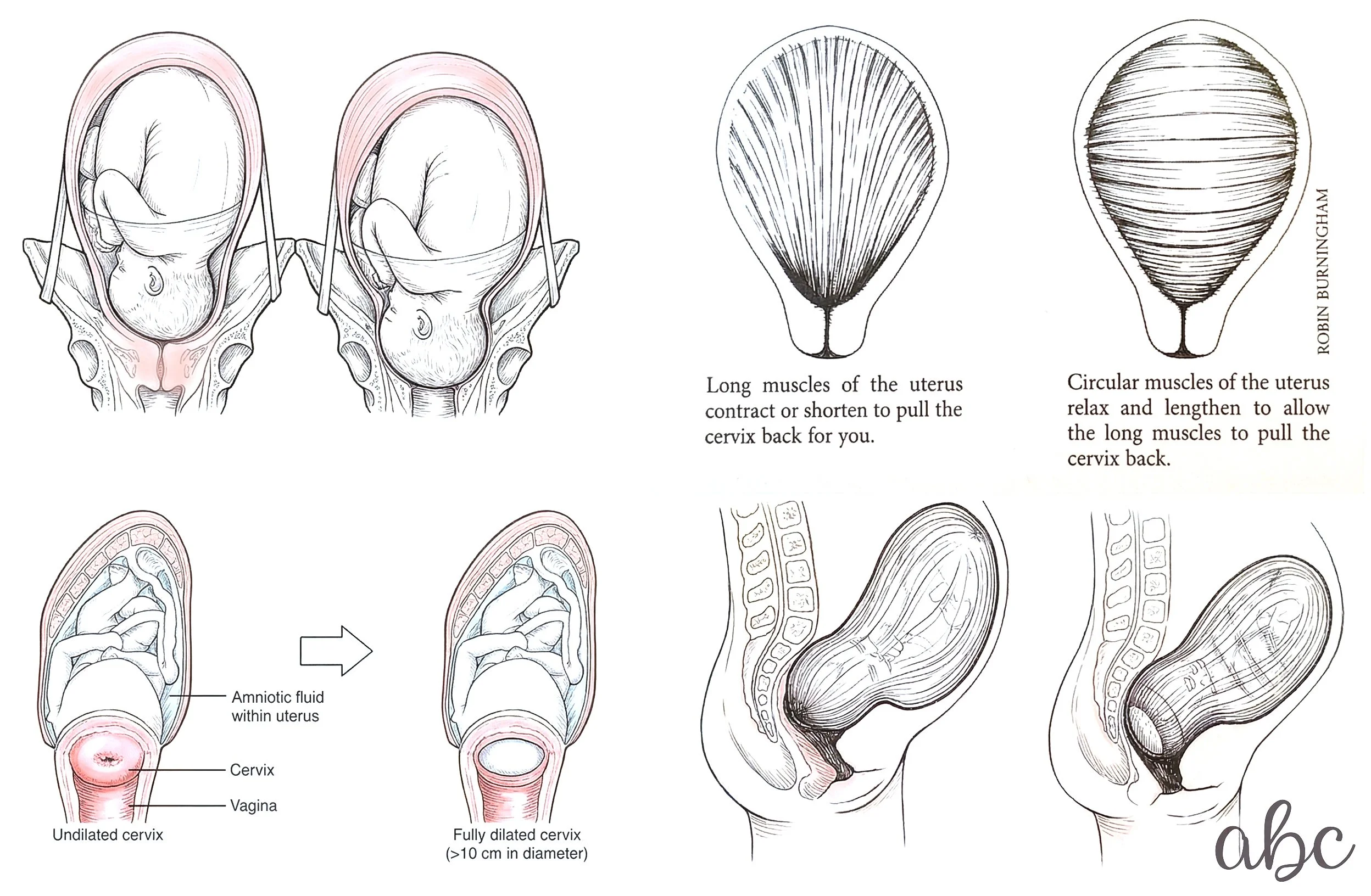
Look at this image. Notice how the cervix thins and pulls back around the baby’s head, (almost like a turtleneck). Notice the muscle fibers working together to pull the cervix back to build the fundus. The fundus is the top of the uterus. It becomes thick and powerful enough to eject the baby. See video below.
Privacy, Communication and the Mammalian Birthing Instinct
Text your doulas to let them know labor is established, and/or send them updates. You probably don’t need to call just yet; a simple update keeps the whole team on the same page. Start timing your contractions for a short window to identify the current pattern, but then put the phone away for a bit.
Spend some time alone. Humans are mammals, and mammals birth best in the dark, in private, and when they feel unobserved. Dilation often happens most efficiently when you aren't being watched or monitored. When you are alone in your "den," your body feels safer to release the oxytocin needed for labor to progress.

When to go to the Hospital
Every labor is a distinct journey. While this protocol provides a solid foundation for laboring at home, we work with each of our families to curate a plan that fits their specific needs. Generally, we look for the 3/4-1-1: contractions that are 3-4 minutes apart, lasting 1 minute, for at least 1 hour. However, your doula will help you read the subtle shifts in your voice and behavior that indicate it is time to move.
*Contraction apps are notorious for telling parents to leave for the hospital at 5-1-1, but we’ve found that’s best for second-timers vs first-time-moms.
When you are leaving the house, consider the time of day and potential traffic to ensure a calm transition. Grab a sugary drink for the ride. This quick burst of glucose provides the immediate energy your muscles need for the final stages of labor. Plus, this will help baby feel awake + active on the monitors. We will help you decide when the right time is to shift from this home-based rhythm to the next phase of your birth plan.

Did you know that you can reach down and catch your own baby in the hospital? Your partner can help too!
Personalized Birth Support with Atlanta Birth Collective
Every labor is a distinct journey that requires more than just a standard checklist. While these steps provide a physiological foundation, the real magic happens in the way we curate this process for your specific needs and environment. Whether you are laboring at home for hours or heading to your birth location sooner, having a team that understands your rhythm makes all the difference. Reach out to us at Atlanta Birth Collective to start tailoring your own protocol so you can move through your labor with confidence and expert support.

Did you know that having a supportive partner makes you breastfeeding journey more likely to succeed? Ask us how Dads can help! We have a list for that too.