How to Handle Contractions, Waves, Surges
Contractions, waves, surges, oh my!
Understanding the physical work of labor allows you to move with your body rather than resisting it. Whether you refer to them as contractions, waves, or surges, these sensations in early labor indicate that your uterine muscles are effectively thinning and opening the cervix. The focus during this phase is on establishing a rhythm and conserving your energy for the work ahead.

The Sphincter Law and Breathing
Horse Lips or Raspberries: Take a deep breath in through your nose. As you exhale, let your lips be completely loose and vibrate them together to make a motorboat or horse sound. This vibration physically forces the jaw to relax. Because the jaw and the pelvic floor are physiologically connected, loosening the mouth helps the cervix and pelvic floor remain soft and open.
The Golden Thread Breath: Inhale deeply through your nose. As you exhale, imagine you are blowing out a fine, thin, golden thread of air through very slightly parted lips. Keep the thread as long and steady as possible. This visualization keeps your focus on a long, controlled exhale, which prevents the short, panicked breathing that can increase tension.
Low Toning: As the intensity of a surge increases, use your exhale to make low-pitched sounds like a deep Oooo or Uuuu. Keep your throat open and your sounds deep in your chest. High-pitched sounds like screaming or Eeee can cause the throat to constrict and the pelvic floor to tighten, while low tones encourage the body to open and descend.
Counting Breath: Inhale through your nose for a count of four. Exhale through your mouth for a count of eight. Making your exhale twice as long as your inhale signals to your nervous system that you are safe, helping to keep your heart rate steady and your mind calm during the discomfort.
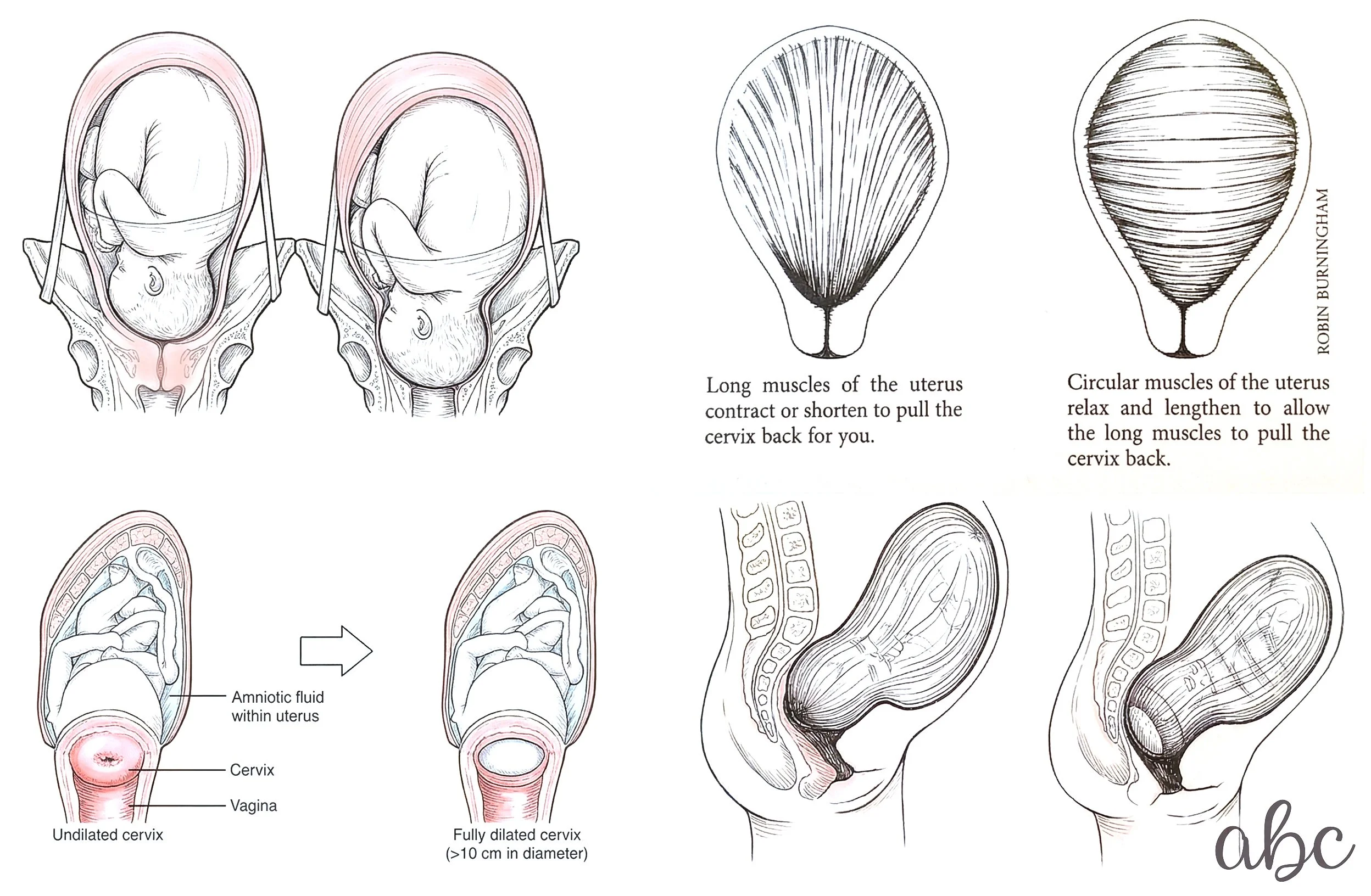
Uterine Imagery and “blowing down and out”: As you begin to feel the beginning of the wave, the tingle, take a deep breath in. Think of your uterus as a powerful bag of muscles. Picture the long muscles flexing and pulling the cervix open, while the circular muscles relax and lengthen in an ever-widening circle. Let it build, it’s just a muscle tightening. As the power becomes intense, begin to exhale. Imagine the letter “J”. You are blowing your exhale down, low. Imagine blowing your baby “down and out” with your exhale, like a letter “J”. Like a “push” but with your breath. You are working with your body to bring baby down. You are blowing away the discomfort, you are blowing your baby down.

Comforted in early labor by her own mother wearing a “Mamas Need Mamas” shirt.
Gate Control Theory and Sensory Tools
The gate control theory is based on the idea that the brain can only process a limited amount of information at one time. By introducing a competing sensation, you can effectively close the gate on some of the discomfort signals reaching the brain from the uterus.
The birth comb: Squeezing a plastic hair comb in the palm of your hand so the teeth press into the crease provides a sharp, distracting sensation. This keeps the brain occupied and can reduce the perceived intensity of the surge.
TENS unit: Transcutaneous Electrical Nerve Stimulation uses small electrodes on the lower back to send gentle electrical pulses. These pulses interrupt the signals being sent to the brain and encourage the body to release its own natural endorphins.
Counter pressure: Firm, steady pressure to your sacrum with a palm or a tennis ball can provide significant relief. This physical pressure helps counteract the internal pressure of the baby moving through the pelvis.

The Floating Technique
This is a full body relaxation tool used to slip over the peak of a wave. Lay on your left side. At the very beginning of a wave, think of your whole body becoming loose and limp all at once. Visualize the contraction as a wave. Let your body sag into the bed and float up to the peak of the wave's strength. By staying limp and floating to the top, you can simply slip over the peak and down the other side. By staying limp and floating to the top, you have not resisted the force. This prevents the tension that often increases discomfort.

Successful VBAC with Nile Midwifery at North Fulton Hospital in Roswell, GA
Hypno-Anesthesia and the Bubble of Peace
You can use mental focus to create a localized sensation of numbness. With the glove anesthesia technique, visualize putting on a heavy, cool, numbing glove. Once your hand feels thick and insensitive, touch the area of your abdomen or back where the intensity is highest to transfer that numbness. You can also imagine a light switch in your mind; during a surge, mentally flip the switch to the off position to dim the signals sent to your brain.
You can also visualize your stomach/uterus/back “glowing” with power and/or “relief”.
The bubble of peace is an internal mental boundary used to protect your headspace. Imagine a clear, shimmering bubble surrounding you. This bubble acts as a filter, allowing only supportive energy and calm thoughts inside. Anything else, such as noises, clinical questions, or external stress, simply bounces off the outside and away from your birth space.

Acupressure and Massage
Specific points can be stimulated to help manage intensity.
The LI4 point, located in the webbing between the thumb and forefinger, is used for general relief.
The SP6 point, found on the inner leg above the ankle, can help the uterus work more efficiently.
Hydrotherapy and Aromatic Anchoring
If you have used a specific organic scent for relaxation during pregnancy, use it now to trigger a calm response. Additionally, use warm water in a tub or a handheld shower directed at your lower back. The warmth and buoyancy provide a natural form of relaxation. In early labor, a warm epsom salt bath can also help determine if the rhythm of your surges is becoming more established.

Movement and Gravity
During these early stages, upright positions allow gravity to assist the baby in pressing against the cervix. Walking, swaying, or leaning against a wall during a wave can help you find a natural rhythm. Remember to rest between surges to keep your strength for the later stages of the journey. Every wave is a productive step toward meeting your baby.

Practice, Prepare, and Support
Every labor unfolds in its own time, and these tools are here to help you navigate each wave with confidence. We encourage you to practice these breathing and visualization techniques now so they feel like second nature when your surges begin. If you found this toolkit helpful, save this post to your favorites for quick reference during early labor. For our current clients, remember to check in with your doula as your rhythm establishes so we can provide the hands-on support you need. You are doing the incredible work of bringing new life into the world, and you don't have to do it alone.