Choose Your Hard: The Realities of Breast vs. Bottle
Fed is best. It’s true. In the world of new parenthood, there is rarely a path that is simply "easy." Instead, most of the decisions we make come down to one philosophy: Choose Your Hard.
Feeding is one of the first major hurdles you will face. Both breastfeeding and bottle feeding come with their own unique sets of challenges and rewards. The difference isn't that one is better than the other; the difference lies in when those challenges show up and what "currency" you use to pay for them. Whether that is your time, your money, or your mental bandwidth.

Breastfeeding: The Front-Loaded Effort
Breastfeeding is often a steep climb at the very beginning, followed by a long, smooth plateau. The challenges here are primarily physical and educational.
The Learning Curve & The Necessity of a Class
Breastfeeding is a biological capability, but it is a learned skill for both you and your baby. Many parents assume it will just "happen," but the reality is that it takes practice. This is why a breastfeeding class is a necessity. Learning the mechanics of a latch, positioning, and how to tell if a baby is getting enough milk is much easier to process before you are sleep-deprived.
The Initial Hurdles
The first few weeks can involve significant discomfort as your body adjusts to the physical demands of nursing. Furthermore, your body remains a shared resource. Some parents find they have to edit their eating habits. Whether that means cutting out certain triggers to help a baby with a sensitive stomach or significantly increasing caloric and water intake to maintain a healthy supply.

In-Depth Health & Development Benefits
The Living Shield: Breast milk is a dynamic substance. It contains live antibodies and white blood cells that actually change composition based on your environment. If you are exposed to a virus, your body creates antibodies and passes them to your baby, providing a customized immune response.
Long-Term Health Stats: Statistically, breastfed babies have lower risks of SIDS, ear infections, and respiratory issues. They are, quite literally, statistically less likely to get sick.
Cognitive Development: Research suggests a correlation between breastfeeding and higher IQ scores or cognitive development, largely due to specific fatty acids like DHA found naturally in human milk that are crucial for brain growth.
The Later Ease
Once you hit the 6-8 week mark and the rhythm is established, breastfeeding becomes a "grab and go" system. There are no bottles to wash, no formula to measure, and the milk is always the perfect temperature and available immediately.

Bottle Feeding: The Long-Term Management
Bottle feeding often feels easier in the immediate postpartum "honeymoon" phase, but the "hard" shows up in the daily logistics and recurring maintenance.
The Early Ease & Mental Health
The biggest benefit of bottle feeding is the ability to get immediate help. When a partner, grandparent, or friend can take a feeding shift, the birthing parent can get a 4-to-6-hour stretch of uninterrupted sleep. In the world of postpartum recovery, sleep is the primary currency for mental health. It allows you to feel less "touched out" and preserves a sense of physical autonomy.
The Trial & Error Nuisance
It is rarely as simple as buying one bottle and one tin of formula. You may find yourself navigating a frustrating period of trial and error, cycling through several different bottle shapes and nipple flows or multiple formula brands to find the one that doesn't cause gas, reflux, or nipple rejection. This can be both a mental and financial drain.

The Daily Grind
The "hard" in bottle feeding is the perpetual cycle of prep work. You are always "one bottle ahead"—washing, drying, and sterilizing parts. Middle-of-the-night feeds require a trip to the kitchen to prep a bottle while a hungry baby waits, which adds a layer of logistical stress to your night.
Shared Bonding
Because anyone can hold the bottle, it allows the entire family to participate in the feeding ritual. This fosters early, deep bonding for partners and siblings who might otherwise feel sidelined during the early weeks.
Breastfeeding Vs Bottlefeeding Costs
When we look at the "cost" of feeding, we have to look at both the bank account and the lifestyle impact.
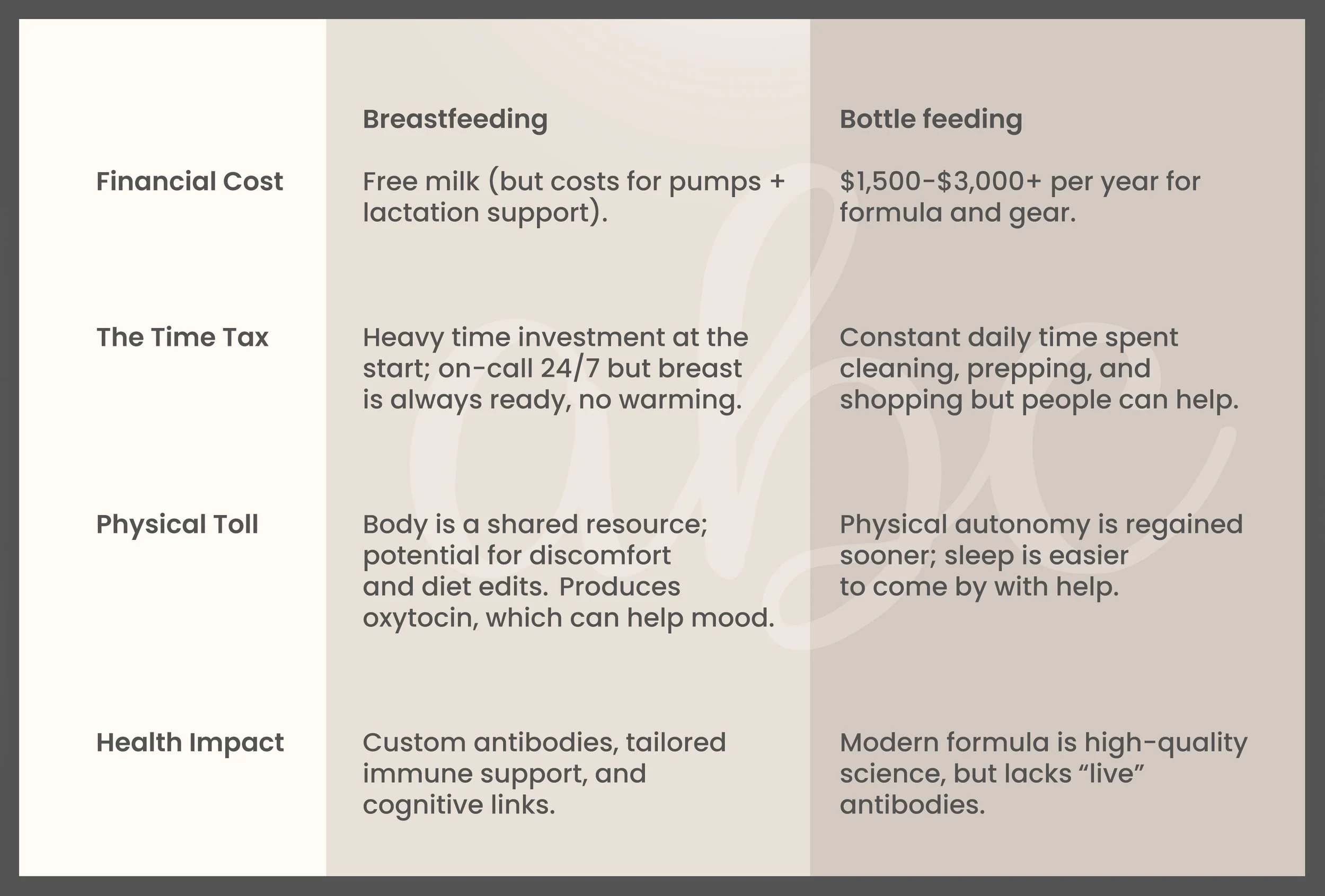
At Atlanta Birth Collective, we don’t view "Breast vs. Bottle" as a moral choice or a test of your love for your baby. We view it as a resource management choice.
If you have the physical capacity and time to navigate the initial learning curve, the long-term convenience and biological benefits of breastfeeding might be your best fit. If your mental health and the ability to share the load are your top priorities, the logistical nuisance and financial cost of bottle feeding are a valid and worthwhile investment.
Both paths lead to a fed baby. Both paths require a parent who is making an intentional, informed choice for their family's specific needs. Whatever "hard" you choose, we are here to support you.
Ready to Navigate Your "Hard" with Support?
Whether you are preparing for the learning curve of breastfeeding or navigating the logistics of bottle feeding, you don't have to do it alone. At Atlanta Birth Collective, we provide expert postpartum doula support and feeding guidance tailored to your family's unique needs in Woodstock, Roswell, and North Atlanta.
Our mission is to turn your "hard" into a manageable, supported journey so you can focus on bonding with your baby.