Chiropractic Adjustments During Labor Can Change Everything
"A mother may suddenly take a deeper breath.
Her shoulders drop and her jaw relaxes.
She begins speaking differently and she can rest between contractions.
She becomes more present. Her partner may even notice that she looks different.
Sometimes contractions become more coordinated.
Sometimes she instinctively changes positions or begins moving in ways she had not before.
Those subtle shifts tell me the nervous system may be regulating more effectively. Often obvious labor progress follows later, but those early signs are what catch my attention first."
That was Webster-certified Chiropractor Samantha Krantz describing the profound shifts she witnesses when adjusting a laboring mother. Having received chiropractic care during her own labor, she knows firsthand how an adjustment can completely turn the tide of a birth.
See Dr Krantz make a difference through chiropractic adjustments, at this birth.
As birth doula photographers at Atlanta Birth Collective, we have spent 25+ years supporting and documenting birth across North Georgia. We have seen these exact, powerful shifts firsthand, and many times we have witnessed chiropractic adjustments change the course of an entire labor! It can be the exact catalyst that helps a baby engage, regulates a mother's nervous system, and fundamentally transforms the trajectory of a stalled birth.
But here is the vital piece of the puzzle: the profound changes we witness in the birth space do not actually start there. For a prenatal chiropractor to offer that level of highly targeted, real-time support, the relationship must be established long before labor begins.
A provider needs to get to know you during pregnancy to understand your specific tension patterns, pelvic alignment, and how your body compensates under stress. You are building a foundation so that when you are in the thick of it, your chiropractor knows exactly what your body needs.
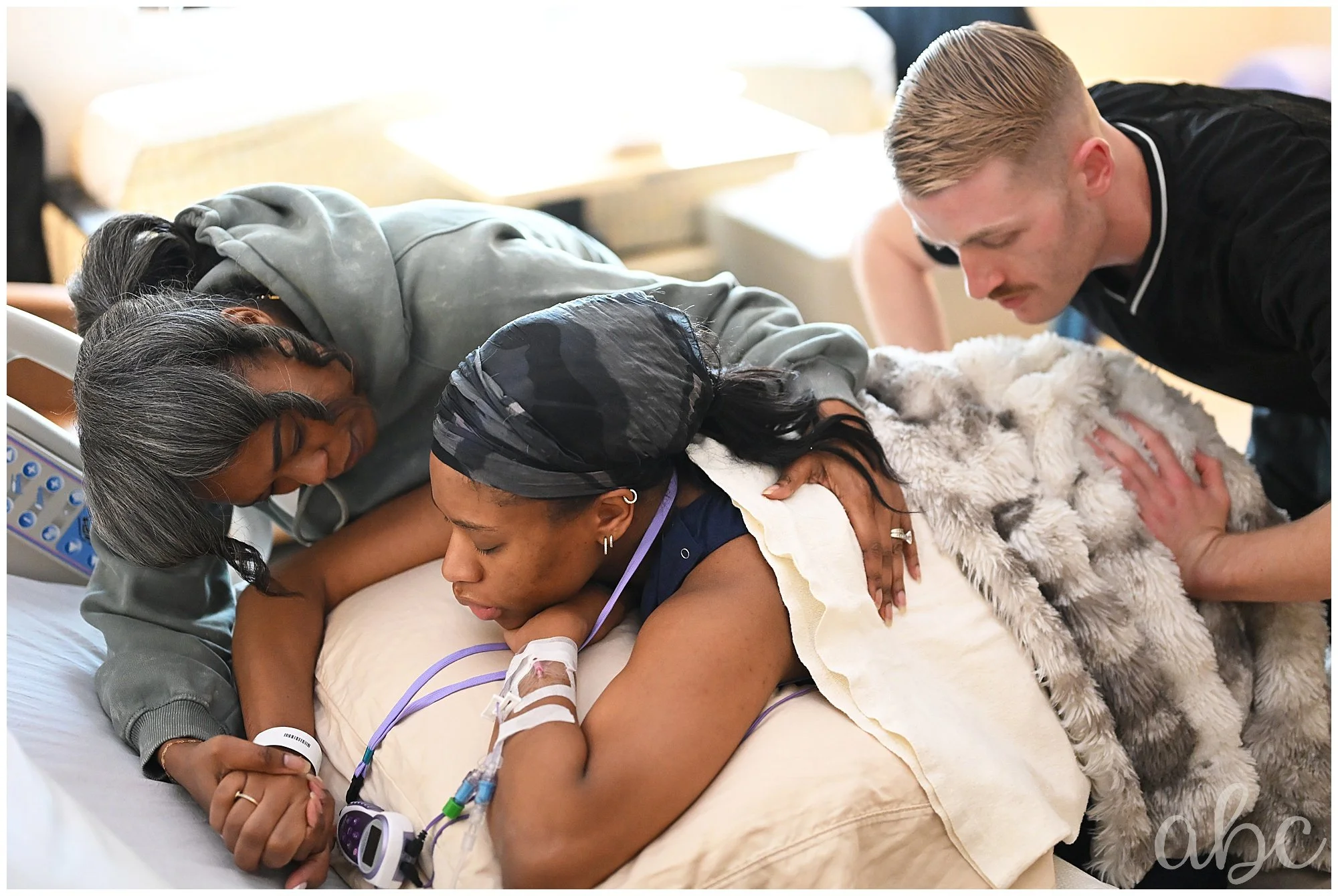
Dad is doing a great job with hip squeezes during this induction at North Fulton Hospital with Midwife Carson Ragan of OB2Me
Meet Dr. Samantha Krantz, DC A second-generation chiropractor adjusted since birth, Dr. Krantz specializes in perinatal and pediatric care. She graduated with top honors from both the College of Charleston and Life University. She is Webster Technique certified, a trained doula, a CPR instructor, and holds over 300 hours of advanced pediatric training through the ICPA.
We sat down with Samantha to discuss why proactive prenatal care is the absolute prerequisite for impactful labor support, what structural support actually looks like during active labor, and how walking through her own birth completely transformed her clinical approach.
Why is treating a mom during pregnancy so vital for helping her later in labor?
Throughout pregnancy, I learn how a mother adapts to physical stress, how her pelvis moves, where she holds tension, how her nervous system responds to challenges, and what compensation patterns consistently appear.
I observe whether she tends to guard one side, whether she struggles with round ligament pain, SI joint discomfort, pubic symphysis dysfunction, rib pain, or postural adaptations. These patterns often tell a story.
By the time labor begins, I have a much better understanding of her body’s tendencies. I know where she may need extra support. I know what positions may feel more comfortable. I know where tension tends to accumulate.
More importantly, I know her.
That relationship matters. Labor is not happening to a stranger whose chart I am reading for the first time. It is happening to someone whose journey I have often been part of for months. That continuity allows me to support both the physical and emotional aspects of labor in a much more meaningful way.

Woodstock Webster-certified Chiropractor Samantha Krantz attends to the laboring mother.
What did your own birth teach you that your chiropractic training couldn’t?
Training taught me the physiology of labor. Experience taught me the humanity of labor.
No textbook can fully prepare you for the vulnerability, uncertainty, and intensity of being the person having the baby. My own birth taught me how powerful reassurance can be. It taught me that confidence can fluctuate from one hour to the next. It taught me how deeply a mother’s environment, support team, and emotional state influence her experience.
Most importantly, it taught me that sometimes what a mother needs is not another explanation. She needs someone who believes in her.
I think that experience has made me a more empathetic chiropractor. When I support pregnant patients now, I understand their fears, hopes, and questions from a very different perspective than I did before becoming a mother.

Was there a specific moment in your own birth that proved how much a chiropractic adjustment matters?
There was. Early in my labor, my father adjusted me. That moment was incredibly meaningful because he has been a chiropractor for over 50 years and has spent his career helping pregnant women and laboring mothers.
Later in labor, after my water broke, things began to feel different. My labor was not progressing the way I expected, and I could feel my body starting to shift into a more protective state. Looking back, I realize I was moving toward a fight-or-flight response.
My father adjusted me again, and I experienced a dramatic change—not necessarily because the adjustment magically made labor happen, but because my body seemed to reorganize itself. My breathing changed. My tension changed. My mindset changed. I felt myself move from protection into trust.
Shortly afterward, labor became more active and productive, and I eventually transitioned into pushing.
That experience reinforced something I had always taught patients: labor is not just about contractions. It is about how well the body is able to coordinate and respond to those contractions. Structural support can sometimes be the factor that allows the body to stop fighting and start working with the process.

Did your own birth change how you view the timing of an adjustment during labor?
Absolutely. Before having my own baby, I understood the value of support throughout labor from a clinical perspective. After living through labor myself, I gained a much deeper appreciation for timing.
There are certain moments in labor when the body is incredibly responsive to support. It is not necessarily about doing more, it is about doing the right thing at the right moment. Sometimes a mother does not need another intervention. She needs reassurance. She needs an adjustment. She needs rest. She needs someone to remind her that what she is feeling is normal.
My own labor taught me that support becomes especially valuable during transitions, plateaus, or moments when fear begins to take over. Those are often the moments where the nervous system can either continue moving forward or become stuck in a protective response.
Now when I support laboring mothers, I think less about the quantity of support and more about recognizing the moment when support will have the greatest impact.

How can we tell the difference between normal labor intensity and a body that is actually struggling to progress efficiently?
Intensity is normal in labor. Labor is hard work. However, there are times when what appears to be normal intensity is actually a sign that the body is struggling to coordinate efficiently.
One thing I pay attention to is disproportionate effort. Is a mother working incredibly hard but not getting the functional changes we would expect? Is she unable to find comfort in any position? Does every contraction seem to create more tension rather than productive movement?
Sometimes I see asymmetrical movement patterns, persistent one-sided discomfort, inability to relax between contractions, or escalating exhaustion. Those signs do not necessarily mean something is wrong, but they can indicate that the body is having difficulty organizing itself around the work of labor.
As chiropractors, we are trained to recognize when structure and nervous system function may be influencing the body’s ability to adapt. Labor is no different.

How is treating a laboring mom different from treating a pregnant mom in your office?
When I am working with a pregnant patient in the office, I am thinking proactively. I am looking at how her body is adapting to the growing baby, how her pelvis is functioning, how her nervous system is regulating, and whether there are patterns that could create challenges later in pregnancy or labor. The goal is preparation, balance, and resilience.
When I am working with a laboring body, my clinical thinking shifts significantly. Labor is not a static process. It is dynamic, moment to moment. I am no longer just looking at structure; I am observing how the body is responding to the work it is actively doing. I am paying attention to movement, breathing patterns, tension, emotional state, positioning, and how the mother is coping between contractions.
One of the biggest differences is that labor requires me to think about function in real time. Is the pelvis able to move the way it needs to? Is the nervous system allowing the mother to shift into a parasympathetic, rest-and-digest state? Is there asymmetry that may be making labor harder than it needs to be?
Many of our moms actually come to the clinic while they are having early contractions or on their way to the hospital or birth center. What I notice repeatedly is that the adjustment is only one part of the experience. There is often a visible shift in their confidence. They walk in uncertain, anxious, or overwhelmed, and they leave feeling supported and capable. Sometimes the most powerful thing we provide is helping a laboring mother reconnect with the belief that her body knows what to do.
About Krantz Chiropractic Clinic
For nearly 50 years, Krantz Chiropractic Clinic has provided trusted, insurance-accepted care to multi-generational families. While treating patients of all ages, the clinic specializes in supporting growing families from preconception through childhood with personalized, evidence-based chiropractic care.
Website: krantzchiroclinic.com
Instagram: https://www.instagram.com/krantzchiropracticclinic